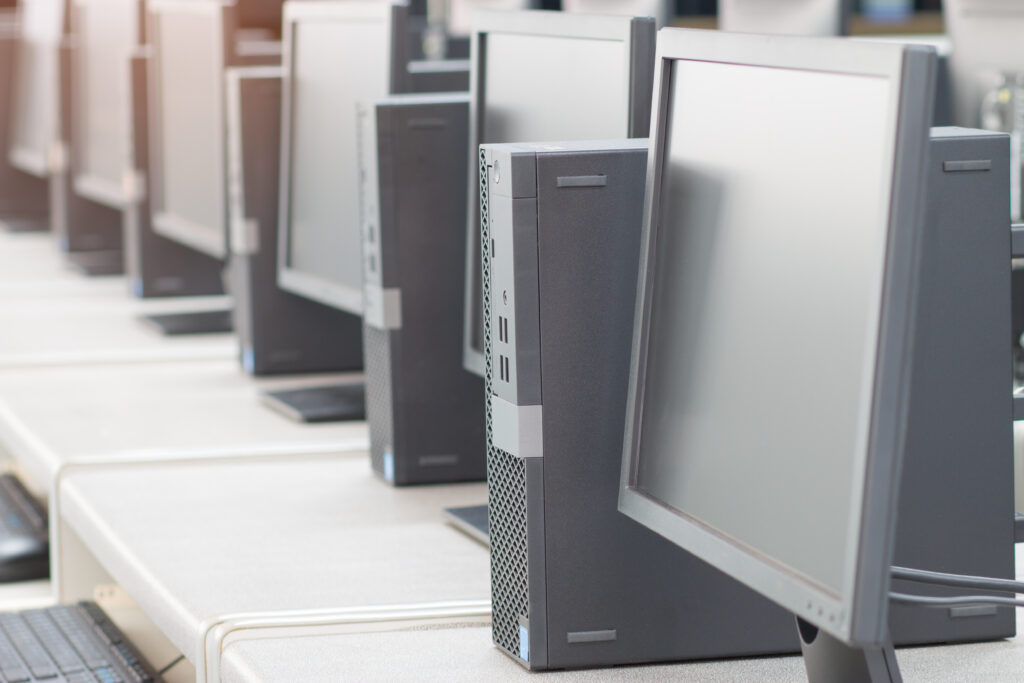



For the last four years, it has been everywhere with you. It has survived thousands of emails, hundreds of Teams calls, more spreadsheets than anyone would care to count and perhaps the occasional coffee related incident.
Then one day, your new laptop arrives. The old one is switched off, handed back to IT and disappears.
But where does it actually go? For organisations replacing tens, hundreds or even thousands of devices at a time, that question matters more than it might seem.
IT Asset Disposition (ITAD) is the process of securely and responsibly managing technology at the end of its working life, covering data sanitisation, chain of custody, resale, reuse and recycling. While a retired laptop has finished its working life with you, there is still value, and risk, left to manage.
Step one: tracking the asset
Before anyone talks about recycling, resale or destruction, there is a more basic question. Do we know exactly what we have?
A good ITAD process starts by identifying and tracking each asset. When retired technology leaves an organisation, there should be a clear chain of custody showing where it has gone, who has handled it and what ultimately happened to it.
The principle is simple. If you hand over 500 laptops, you should be able to account for 500 laptops at the other end.
Step two: secure data sanitisation
Our imaginary laptop might look empty. The employee has logged out, files have been moved, and the device may even have been factory reset.
But when it comes to corporate information, probably gone is not good enough. Secure ITAD includes proper data sanitisation, and evidence that it has been completed successfully.
Through Grace’s ITAD solution, suitable devices can be securely sanitised using Blancco data erasure technology, with the outcome verified and documented.
If data cannot be securely sanitised, the storage media can instead be physically destroyed, with G1 Asset Management offering military grade physical destruction down to a 3 mm particle size where required.
The important part is not simply that the data is gone. It is being able to prove it.
Step three: resale, refurbishment or recycling
Once the information has been securely dealt with, what happens to the device itself?
- Resale. If the device still has commercial value, it may be suitable for resale, allowing the organisation to recover some of its original investment.
- Refurbishment. If it has useful life but is not commercially viable for resale, refurbishment may give it another purpose.
- Recycling. Only when reuse is not appropriate does responsible recycling become the next step.
That old laptop sitting in the IT storeroom is not necessarily rubbish. It could be an asset your organisation has not yet realised the value of.
A second life through digital access programs
Through Grace’s partnership with G1 Asset Management, eligible retired technology can be securely sanitised and refurbished through Digital Access Australia.
Rather than becoming e-waste, suitable devices can be given a second life, helping improve access to technology for people and communities experiencing digital disadvantage. For the organisation retiring the device, this creates an opportunity to reduce e-waste, support a more circular economy and turn an everyday IT refresh into a positive social outcome.
When recycling is the right outcome
Responsible e-waste recycling is not the same as sending old technology to landfill and hoping for the best. IT equipment contains materials that can potentially be recovered and recycled, alongside components that need to be handled appropriately.
A considered ITAD process helps ensure equipment that has genuinely reached the end of its useful life is sent through an appropriate recycling pathway, with the reporting and certification to show what happened to it.
Why there is no single right answer
Maybe a device is securely sanitised and resold. Maybe its storage media requires physical destruction. Maybe it is refurbished and given a second life. Or maybe it genuinely has reached the end and is responsibly recycled.
There is not one right destination for every retired IT asset. That is really the point. Good ITAD is not about finding a faster way to get rid of old technology. It is about making the right decision for each asset, considering its data, security requirements, residual value, useful life and environmental impact.
At Grace, we believe information should be protected throughout its entire lifecycle, right through to the secure retirement of every IT asset.
Ready to retire IT right?
We have created Retire IT Right: A Practical ITAD Playbook to help you take a closer look at your organisation’s approach to end of life technology.
From secure data sanitisation and chain of custody to value recovery, sustainability and choosing the right ITAD provider, it is a practical guide to getting more from your end-of-life technology.